Disclaimer: Content reviewed and maintained by the clinical team at Hillside Primary Care. This content is provided for educational purposes only and is not a substitute for professional medical advice. Consult a qualified healthcare provider.
Your skin can reveal changes that are easy to miss during everyday routines. A wellness visit gives your doctor an opportunity to look for unusual moles, new growths, or other skin changes that may need closer evaluation. Skin cancer screening can help identify concerning changes early, especially when you have risk factors such as frequent sun exposure or a history of skin conditions.
A mole you’ve had for years suddenly looks a little different. It’s easy to talk yourself out of mentioning it; it’s probably nothing, right? That instinct to wait and see is exactly what skin cancer screening is designed to override. Understanding what your doctor looks for during a routine skin check can help you stay proactive about your overall health.
Skin cancer is the most commonly diagnosed cancer in the United States, more common than all other cancers combined, and it’s also one of the most treatable when caught early. This guide covers what a skin check for cancer during a wellness visit actually involves, the warning signs worth knowing, and why routine screening matters even if nothing about your skin feels obviously wrong.
Why Skin Cancer Screening Deserves Real Attention
An estimated 104,960 new cases of invasive melanoma, the most dangerous form of skin cancer, were projected in the U.S. in 2025 alone. At least one in five Americans will develop some form of skin cancer by age 70.
And the difference early detection makes is stark: melanoma caught before it spreads has a five-year survival rate above 99%, but that number drops sharply, to around 35%, once the disease has spread to distant parts of the body.
That gap, between a number in the high 90s and a number in the 30s, is the entire argument for skin cancer screening. It’s not a test that finds something scary most of the time. It turns a potentially serious diagnosis into a highly treatable one, provided it happens early enough.
What a Skin Check During a Wellness Visit Actually Involves
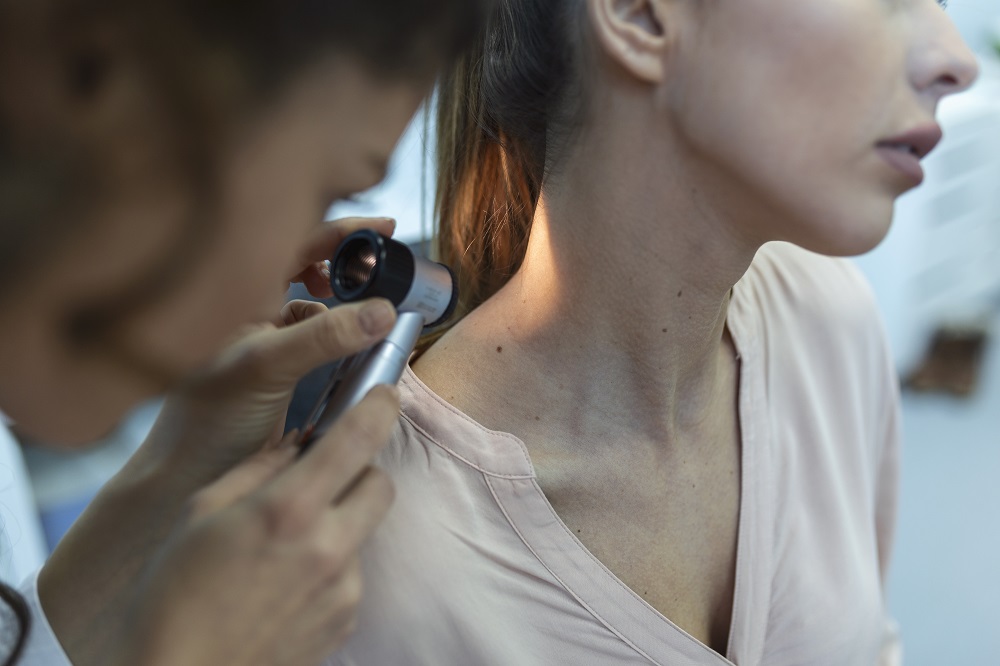
A skin check for cancer during an Annual Wellness Visit isn’t the same as a dermatology-level, head-to-toe skin exam with specialized tools. It’s a visual review of easily accessible skin, along with a conversation about your sun exposure history, prior skin cancers, and any spots that concern you.
What your provider is generally looking for:
- New moles or growths that weren’t there before
- Existing moles that have changed in size, shape, or color
- Sores that don’t heal within a few weeks
- Rough, scaly patches that could indicate a precancerous lesion
- Areas of skin that look notably different from the surrounding tissue
The ABCDE Rule: What to Watch For Yourself
Between wellness visits, self-checks matter, and dermatologists teach a simple framework for evaluating moles:
| Letter | What to Look For |
| A – Asymmetry | One half of the mole doesn’t match the other |
| B – Border | Edges are irregular, ragged, notched, or blurred |
| C – Color | Uneven shading, or multiple colors within one spot |
| D – Diameter | Larger than 6mm, roughly the size of a pencil eraser. Melanomas can be smaller than 6 mm. |
| E – Evolving | Any change in size, shape, color, or texture over time |
Who’s at Higher Risk
Skin cancer risk isn’t distributed evenly. Several factors meaningfully raise it:
- Fair skin, light eyes, or red or blonde hair: Less natural protection from UV damage
- A history of sunburns: Having five or more sunburns in your lifetime roughly doubles melanoma risk
- Significant lifetime sun exposure: Outdoor work, outdoor hobbies, or growing up in a sunny climate all add up
- Tanning bed use: A well-established risk factor, particularly when started at a younger age
- Personal or family history of skin cancer: Prior diagnoses raise the likelihood of future ones
- High number of moles, or atypical moles: More surface area to monitor means more opportunity for a change to go unnoticed
- Weakened immune system: Certain medications and conditions increase risk
What Happens If Something Looks Concerning
Finding something that fits the ABCDE criteria doesn’t mean a cancer diagnosis. It means it’s worth a closer look. The only way to know for sure is to have it evaluated rather than watch and wait on your own. The typical path from there:
- Your primary care provider documents the spot and discusses your history and risk factors
- A referral to a dermatologist is made for a more detailed evaluation
- If the dermatologist has concerns, a biopsy, removing a small skin sample for lab testing, confirms or rules out cancer
- If cancer is confirmed, treatment for early-stage skin cancer starts
The Three Main Types of Skin Cancer
Not all skin cancer behaves the same way, and understanding the differences helps explain why screening approaches vary by what’s found.
| Type | How Common | Typical Behavior |
| Basal cell carcinoma | Most common type overall | Grows slowly, rarely spreads, but can cause local damage if ignored |
| Squamous cell carcinoma | Second most common | Grows faster than basal cell; can spread if left untreated |
| Melanoma | Less common than the other two | Accounts for the large majority of skin cancer deaths; can spread quickly if not caught early |
How to Do a Skin Self-Exam Between Visits
Waiting a full year between checks isn’t necessary, or ideal, given how much can change in that time. A simple self-exam every few months helps you notice changes early enough to bring them up before your next scheduled visit.
- Use a full-length mirror and a hand mirror for hard-to-see areas
- Check your scalp, ears, and the back of your neck, areas easy to overlook
- Examine your back, either with a mirror or by asking a partner to take a look
- Don’t skip the palms, soles, and the spaces between fingers and toes
- Note the date and take a photo of any spot you’re monitoring, so a subtle change over months is easier to catch than relying on memory alone
If anything looks new, has changed, or matches the ABCDE pattern, don’t wait for your next scheduled wellness visit to bring it up..
How Hillside Primary Care Approaches Skin Cancer Screening
A rushed visit that skips a visual skin check misses one of the most consequential parts of preventive care. Catching a concerning spot early is the difference between a simple procedure and a much harder road.
What that looks like at Hillside Primary Care:
| What It Means for Skin Cancer Screening | |
| Skin checks built into the Health Risk Assessment | Sun exposure history and visible concerns get a real conversation, not a skipped step |
| Providers who track risk factors over time | A changing mole gets compared to what was noted at a prior visit |
| 18 Texas locations, 40+ providers | A dermatology referral is easy to coordinate close to home when something needs a closer look |
| Same-day appointments at every location | A new or changing spot gets seen promptly, not weeks later |
| Continuity of care | The same provider following your skin over years is more likely to notice a subtle change than a one-time visit ever could |
Final Thoughts
Skin cancer screening turns a “probably nothing” instinct into a real answer, and that answer matters. The survival rate for melanoma caught early sits above 99%; caught late, it falls dramatically. A visual skin check during your Annual Wellness Visit costs a few minutes and catches exactly the kind of change that’s easy to dismiss on your own. If you’ve noticed a spot that fits the ABCDE pattern, or if it’s just been a while since anyone looked, bring it up at your next visit.
FAQs
Q1. How often should I get a skin cancer screening?
Annually for most adults, more often with a personal or family history of skin cancer or significant sun exposure.
Q2. What does the ABCDE rule stand for?
Asymmetry, Border irregularity, Color variation, Diameter over 6mm, and Evolving size, shape, or color.
Q3. Can skin cancer appear without a pre-existing mole?
Yes. Most melanomas can develop on skin that previously looked completely normal.
Q4. Is a wellness visit skin check the same as a dermatology exam?
No. It’s a brief visual review; a dermatologist performs a more thorough, specialized full-body exam.
Q5. Does sunscreen actually reduce skin cancer risk?
Yes. Regular daily sunscreen use has been shown to meaningfully lower the risk of developing melanoma over time.
About the Author