Disclaimer: Content reviewed and maintained by the clinical team at Hillside Primary Care. This content is provided for educational purposes only and is not a substitute for professional medical advice. Consult a qualified healthcare provider.
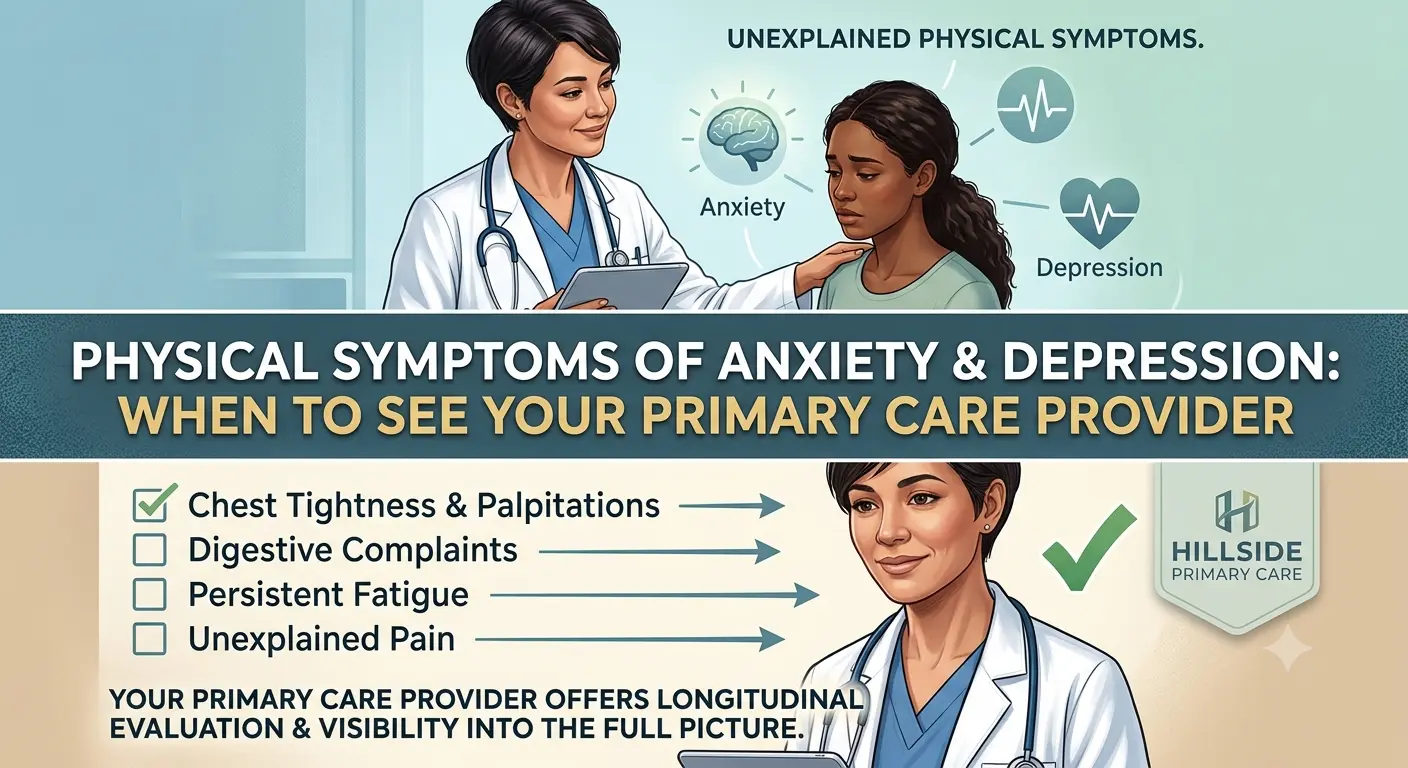
Unexplained physical symptoms are one of the most common reasons anxiety and depression go undiagnosed for months or years. Patients present with chest tightness, digestive complaints, or persistent fatigue, receive normal test results from one or more specialists, and are left without a clear explanation. In a substantial number of these cases, the underlying cause is anxiety or depression manifesting physically, not a missed diagnosis in another organ system.
This article outlines which physical symptoms are clinically associated with anxiety and depression, how they differ, and how a primary care evaluation determines whether a physical or psychological cause, or both, is responsible.
The Physiological Basis for Somatic Symptoms
Anxiety and depression are not purely psychological events. Both conditions produce measurable physiological changes. Chronic activation of the stress response keeps cortisol and adrenaline elevated beyond their intended short-term function, which affects cardiovascular, digestive, and musculoskeletal systems over time.
Prolonged anxiety also drives sustained muscle tension and disrupts normal sleep architecture, while depression is associated with elevated inflammatory markers and altered pain processing.
This physiological basis explains why symptoms often present in whatever system is already sensitive for a given patient. Someone with a family history of cardiac issues is more likely to notice palpitations first; someone with a sensitive digestive system is more likely to present with gastrointestinal symptoms.
The underlying driver can be identical while the presenting complaint varies significantly between patients, which is a primary reason these conditions are frequently misattributed to isolated organ-system problems.
Symptom Patterns Associated With Anxiety
Anxiety symptoms are largely driven by activation of the sympathetic nervous system, the physiological fight-or-flight response, triggered without an actual external threat present.
- Cardiovascular: Tachycardia, heart palpitations, chest tightness, frequently the presenting complaint in emergency settings
- Respiratory: Shortness of breath, sensation of air hunger, hyperventilation during acute episodes
- Gastrointestinal: Nausea, cramping, diarrhea, or persistent digestive discomfort without a dietary trigger
- Musculoskeletal: Neck and shoulder tension, jaw clenching (often identified through dental wear or morning headaches), tremor
- Neurological: Dizziness, paresthesia (tingling) in extremities, tension-type headache
- Sleep: Difficulty initiating sleep due to hyperarousal, frequent nighttime waking
Acute anxiety symptoms, such as those in a panic attack, tend to peak rapidly, often within ten minutes, while other anxiety-related symptoms accumulate gradually over weeks of sustained stress exposure.
Symptom Patterns Associated With Depression
Depression’s physical symptoms typically develop more gradually and are more likely to be attributed to an unrelated cause, which contributes to delayed diagnosis.
- Energy regulation: Persistent fatigue unresponsive to rest; hypersomnia or insomnia
- Appetite and weight: Unintentional weight change in either direction
- Pain: Diffuse, unexplained pain, particularly in the back, joints, and head; depression measurably lowers pain threshold
- Psychomotor function: Observable slowing of movement or speech, or conversely, restlessness and agitation
- Cognition: Impaired concentration, memory difficulty, and decision-making fatigue
- Gastrointestinal: Appetite disruption frequently accompanies changes in bowel regularity
When anxiety and depression occur together, which research shows happens in a substantial proportion of diagnosed cases, symptom presentations from both lists commonly overlap in the same patient: fatigue alongside a racing heart, or appetite loss alongside chronic muscle tension.
Comparative Symptom Profile
| Clinical Feature | More Characteristic of Anxiety | More Characteristic of Depression |
| Heart rate | Elevated, palpitations | Typically unaffected |
| Energy state | Hyperaroused, restless | Diminished, heavy |
| Sleep disturbance | Difficulty falling asleep | Oversleeping or early-morning waking |
| Appetite | Often decreased, nausea | Increased or decreased |
| Pain presentation | Localized tension, headache | Diffuse aching, joint pain |
| Symptom onset | Acute spikes | Gradual, sustained decline |
Diagnostic Overlap and Common Misattribution
A significant contributor to delayed diagnosis is the structure of episodic care. An emergency department or urgent care visit is designed to rule out acute, immediately dangerous causes; a normal EKG after a chest-pain visit is genuinely reassuring, but it does not explain a pattern of recurring tightness over several weeks. That explanatory step requires longitudinal evaluation, which single-visit acute care is not structured to provide.
Symptom distribution across specialties compounds the problem. Two patients with clinically identical underlying anxiety may present to a cardiologist and a gastroenterologist respectively, each receiving normal test results within their specialty, with no single provider positioned to connect the pattern across systems.
A primary care physician, by contrast, has visibility into the full symptom picture and the patient’s broader history, which is precisely the vantage point needed to identify a shared underlying cause.
When to See Your Primary Care Provider for Physical Symptoms
Physical symptoms related to anxiety and depression should never be dismissed without proper medical evaluation. While stress and mental health conditions can contribute to symptoms such as fatigue, headaches, chest discomfort, or digestive issues, these same symptoms may also signal an underlying medical condition that requires prompt treatment.
The following framework can help you determine how quickly to seek care. It is not intended to help you diagnose yourself. If you’re ever unsure about the severity of your symptoms, it’s safest to seek medical attention rather than delay evaluation.
Call 911 or Go to the Emergency Room Immediately
Some physical symptoms require emergency care because they may indicate a heart attack, stroke, or another life-threatening medical condition, not anxiety or depression.
Seek immediate medical attention if you experience:
- Chest pain or pressure that spreads to your arm, shoulder, jaw, neck, or back, especially if it’s accompanied by shortness of breath, nausea, dizziness, or sweating.
- A sudden, severe headache unlike any headache you’ve experienced before.
- Sudden weakness or numbness on one side of the body, facial drooping, difficulty speaking, or confusion.
- Fainting or loss of consciousness, particularly if it occurs without a clear explanation.
- Thoughts of self harm. Call 911 or contact the 988 Crisis Lifeline immediately for emergency support.
Although anxiety can sometimes cause symptoms that resemble a medical emergency, it’s essential to rule out serious conditions first. Emergency symptoms should never be assumed to be caused by stress alone.
Book an Appointment Within the Next Few Days
Many physical symptoms are not emergencies, but they should still be evaluated promptly if they are new, persistent, worsening, or interfering with your daily life.
Early assessment allows your primary care physician to determine whether the symptoms are related to anxiety, depression, another medical condition, or a combination of factors.
Schedule an appointment within the next few days if you have:
- New or worsening physical symptoms without an obvious cause.
- Chest tightness, stomach pain, dizziness, or muscle tension that persists for more than two weeks.
- Fatigue that continues despite adequate rest and affects your ability to work, exercise, or complete daily activities.
- Difficulty falling asleep, staying asleep, or excessive sleeping for more than two weeks.
- Physical symptoms accompanied by changes in mood, appetite, motivation, or interest in daily activities.
- Unexplained weight loss or significant changes in appetite.
Persistent symptoms should not be managed with a “wait and see” approach.
A primary care evaluation can help identify underlying medical conditions, screen for anxiety or depression when appropriate, and determine whether additional testing or treatment is needed. If you’re experiencing any of these symptoms, consider scheduling an appointment through the Hillside Primary Care booking page.
Bring It Up at Your Next Routine Visit
Some symptoms may not require an urgent appointment but are still worth discussing with your healthcare provider. Even if they’ve improved or occur only occasionally, they can provide valuable information about your overall health.
Mention these concerns during your next routine visit if you have:
- Mild or occasional physical symptoms that are not disrupting daily activities.
- Symptoms that have improved but you would like to understand their possible cause.
- A family history of anxiety, depression, or other mental health conditions that may increase your risk.
- Questions about stress management, sleep quality, or emotional well-being.
Sharing these concerns allows your primary care physician to monitor changes over time, recommend preventive strategies, and identify potential issues before they become more serious.
When in doubt, seek medical advice. This framework is intended to help guide your decision, not replace professional medical judgment. If you’re uncertain whether your symptoms require immediate attention, it’s always safer to contact a healthcare provider or seek emergency care if you believe your condition may be serious.
Medical Conditions Frequently Mistaken for Anxiety or Depression
Several common medical conditions produce symptom profiles that overlap substantially with anxiety and depression, which is a primary reason laboratory testing is a standard part of the evaluation rather than an optional step.
| Condition | Overlapping Symptoms | Distinguishing Test |
| Hypothyroidism | Fatigue, low mood, weight gain, brain fog | TSH and free T4 |
| Hyperthyroidism | Racing heart, anxiety, tremor, weight loss | TSH and free T4 |
| Anemia | Fatigue, difficulty concentrating, low energy | Complete blood count, ferritin |
| Vitamin B12 or D deficiency | Fatigue, low mood, cognitive slowing | Serum B12 and vitamin D levels |
| Blood sugar irregularities | Shakiness, irritability, anxiety-like symptoms | Fasting glucose, HbA1c |
Identifying one of these conditions does not necessarily rule out a co-occurring anxiety or depressive disorder; the two can and often do coexist. But treating the underlying medical condition first, or in parallel, materially changes both the treatment plan and the timeline for symptom improvement.
This is the core clinical reasoning behind ordering labs before finalizing a mental health diagnosis, rather than treating it as a formality.
Modifiable Factors That Intensify Physical Symptoms
Several everyday exposures measurably intensify both the psychological and physical symptoms of anxiety and depression, and are worth reporting to a physician even though they are not the root cause.
- Caffeine intake masks fatigue while impairing sleep quality, compounding both anxiety and depressive symptoms the following day.
- Alcohol produces a similar delayed effect: short-term relaxation followed by disrupted sleep architecture and measurable mood decline over the subsequent one to two days.
- Irregular eating patterns and high-glycemic diets contribute to blood glucose fluctuations that can mimic or intensify anxiety symptoms directly.
- Reduced physical activity, even over a period as short as two weeks, is independently associated with increased physical tension and lower mood.
None of these factors substitute for clinical treatment of a diagnosed condition, but disclosing them during an evaluation gives a physician a more complete diagnostic picture and often identifies straightforward adjustments that reduce symptom severity alongside formal treatment.
Clinical Indicators for Scheduling an Evaluation
Several criteria distinguish symptoms that warrant a formal evaluation from typical situational stress:
- Symptoms persisting beyond two weeks without improvement
- Measurable interference with work performance, sleep, or relationships
- A recurring pattern tied to specific triggers or timing
- No improvement with standard self-care measures
- Normal results from prior testing, with symptoms continuing despite that reassurance
Persistent symptoms following unremarkable testing are a legitimate reason to shift the evaluation toward anxiety and depression screening, rather than pursuing additional testing for the same physical symptom through a different specialty.
Chest pain that is sudden, severe, or accompanied by radiating pain, particularly into the arm or jaw, requires emergency evaluation to rule out a cardiac event before any assumption about an anxiety-related cause is made.
The Evaluation Process
A structured primary care evaluation for these symptoms generally proceeds in a defined sequence.
The visit begins with a detailed history: symptom duration, triggers, and any recent life changes. A physical exam follows, including vital signs and a targeted assessment for findings suggesting a physical cause.
Laboratory testing is standard practice at this stage. Thyroid panels, complete blood counts, vitamin D and B12 levels, and glucose testing screen for conditions that closely mimic anxiety or depression.
Thyroid dysfunction in particular is well documented for producing symptoms nearly indistinguishable from a primary mood disorder, and identifying it early prevents months of treatment directed at the wrong condition.
Once physical causes are addressed, screening moves to validated instruments, the GAD-7 for anxiety and the PHQ-9 for depression, followed by a treatment plan calibrated to symptom severity, which may include lifestyle intervention, medication, therapy referral, or a combination of these.
Why Primary Care Should be the First Point of Contact
Directing an isolated symptom straight to an organ-specific specialist, a cardiologist for palpitations, a gastroenterologist for digestive symptoms, is sometimes appropriate, but it frequently produces a slower path to an accurate diagnosis than starting with a primary care evaluation. A specialist meeting a patient for the first time has access to one system in isolation.
A primary care physician with an existing relationship has access to the patient’s full history: prior thyroid results, family history of mood disorders, and the timing of symptom onset relative to life events. That context materially shortens the path to an accurate diagnosis.
Hillside Primary Care structures its evaluation process around this whole-patient approach — reviewing medical history, conducting a physical exam, and ordering appropriate laboratory testing before determining whether symptoms are primarily physical, primarily related to anxiety or depression, or a combination of both. The practice operates locations across San Antonio, including Stone Oak, Westover Hills, and Southside, along with offices in Schertz, Cibolo, Killeen, and El Paso, with same-day appointments available for symptoms that warrant timely evaluation.
Final Thoughts
Physical symptoms linked to anxiety and depression are physiologically real, clinically well documented, and treatable, and identifying the correct cause does not require the patient to determine in advance whether the origin is physical or psychological. That determination is the function of a structured primary care evaluation. Persistent fatigue, chest tightness, digestive symptoms, or unexplained pain lasting more than two weeks warrant an appointment.
Hillside Primary Care offers same-day evaluations across its San Antonio-area and Central and West Texas locations. Appointments can be scheduled by calling (210) 742-6555 or booking online.
FAQs
Can anxiety cause chest pain that mimics a heart attack?
Yes. Anxiety-related chest tightness is common, though sudden severe pain still requires emergency evaluation to rule out cardiac causes.
Why does depression cause physical exhaustion even with adequate sleep?
Depression disrupts sleep quality and energy regulation at a physiological level, producing fatigue independent of total sleep duration.
Should physical symptoms go directly to a specialist instead of primary care?
Primary care evaluation is typically faster and more accurate, since it assesses the full symptom picture rather than one organ system.
How does a physician distinguish physical causes from anxiety-related symptoms?
Through history, physical exam, and laboratory testing that rules out physical causes before confirming an anxiety or depression connection.
Does treating anxiety or depression reduce related physical symptoms like pain?
Yes. Appropriate treatment of the underlying condition typically reduces associated fatigue, pain, and gastrointestinal symptoms significantly.
About the Author